He Answered a Part-Time Job Ad. He Ended Up a Suspect in a Money-Laundering Case.
A young man in Dubai — Dubai Police identify him only as "S" — answered a part-time job advertisement online. Easy money, simple tasks, work from home. Within days he had unknowingly turned his own bank account into a channel for stolen money, and become a criminal suspect in the process.
Dubai Police made his case public this month as a warning, and it is worth reading closely, because the scam it describes is running in the UAE right now, and the ending is not the one most victims expect.
What actually happened
"S" responded to an online advertisement offering part-time work. The people behind it claimed to represent an overseas financial services company. He was accepted quickly — no real interview, no real vetting, just fast approval, which should have been the first warning sign.
He was then instructed to use his own bank account "for administrative purposes." Money began arriving in the account. He was told to forward it on to other accounts, and that doing so would earn him a commission. He believed, the whole time, that he was processing legitimate customer transactions for a real company.
He was not. That money was stolen, moved through his account to obscure where it actually came from — a technique with a name: money muling. And Dubai Police were direct about the consequence: using your bank account to move funds this way, even unknowingly, can expose you to legal consequences for facilitating financial crime.
Not the scammer who designed it. You, the person whose account carried the money.
The pattern, so you recognise it before it recognises you
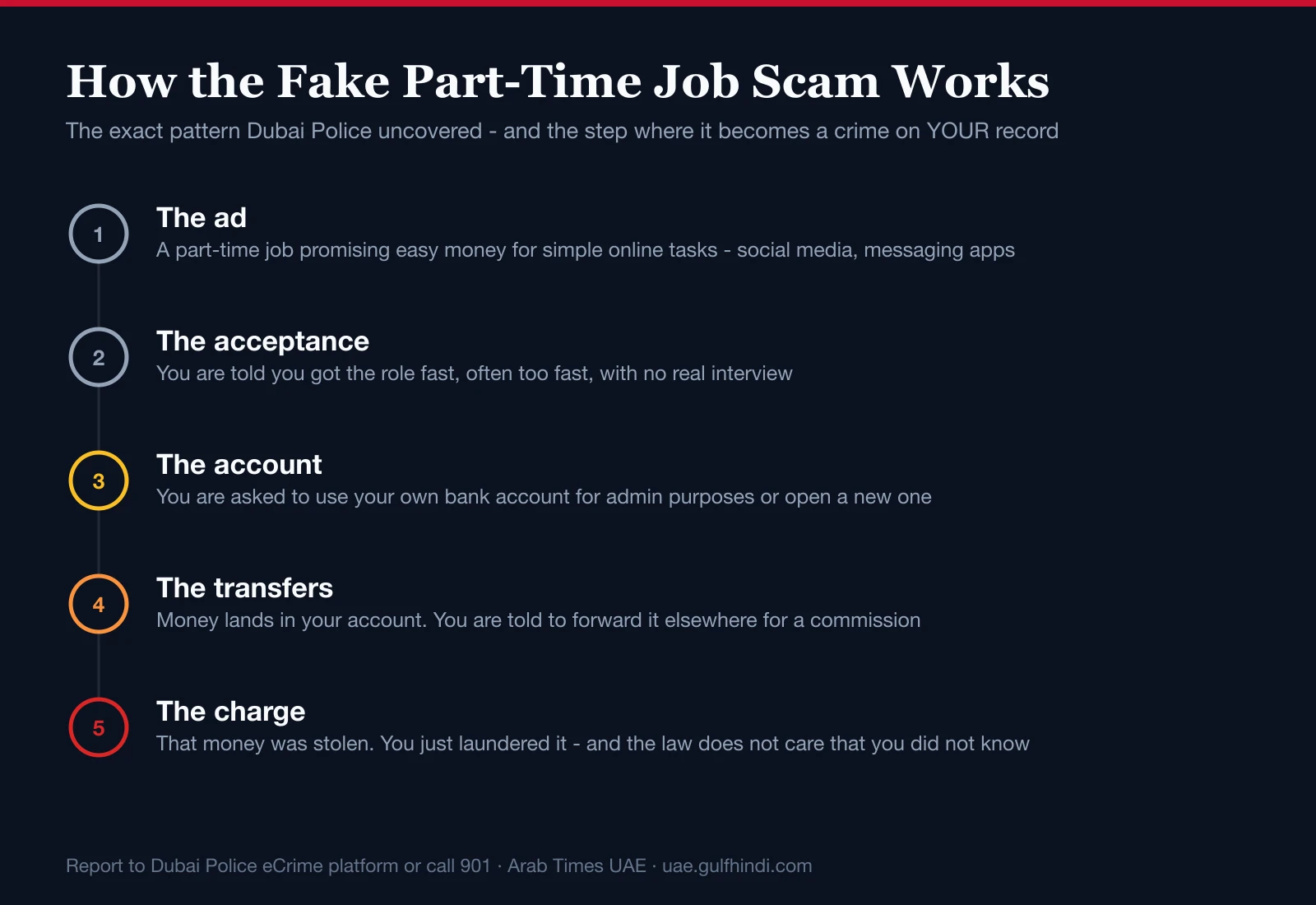
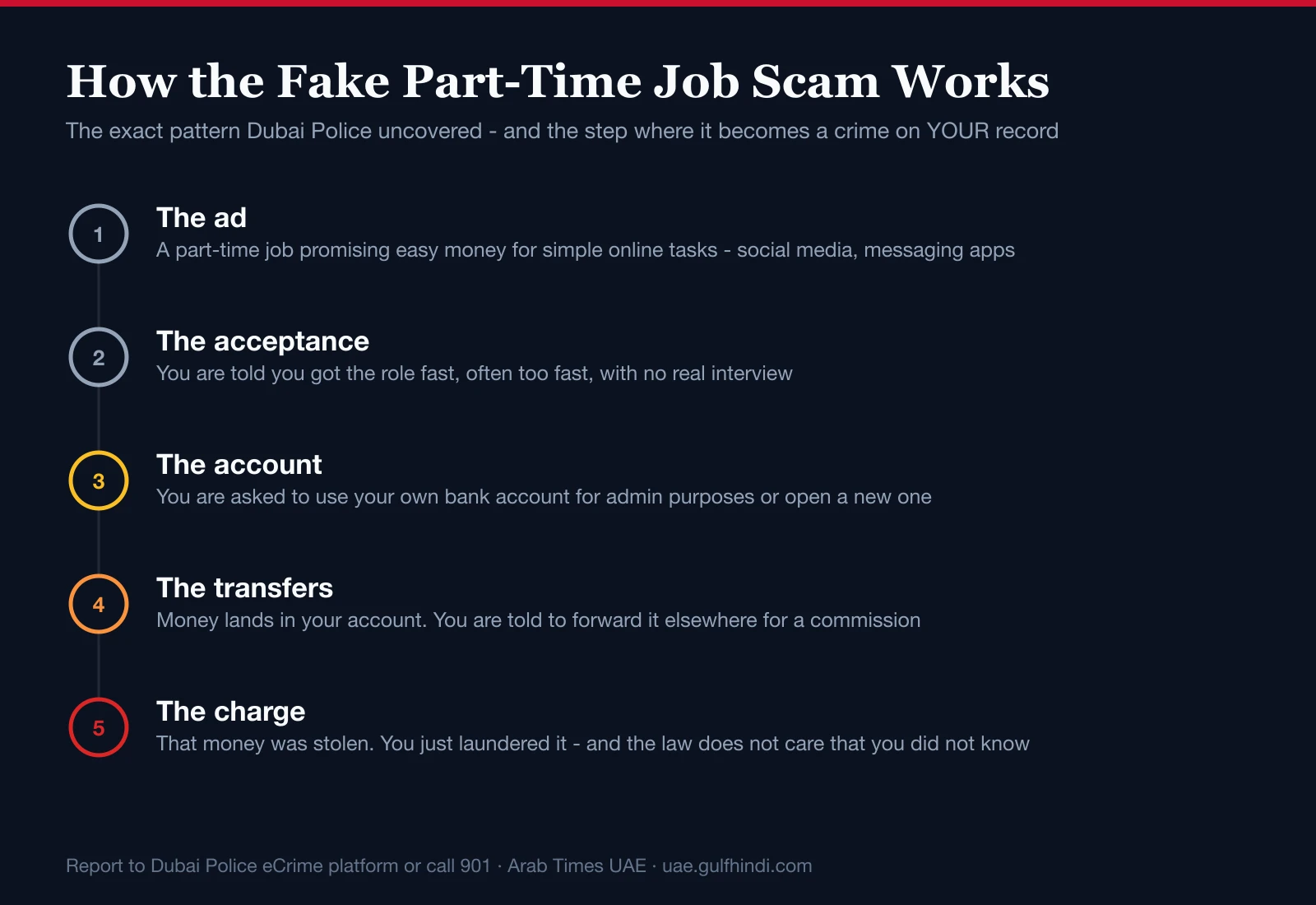
The ad. It arrives on social media or through a messaging app, promising easy earnings for simple online tasks — no real skill required, no real company name you can independently verify.
The acceptance. It comes fast. Too fast. A real job takes an interview, references, a process. A scam takes a reply.
The account. This is the pivot point. You're asked to use your existing bank account "for administrative purposes," or to open a new one specifically for the role. This request, on its own, is the clearest signal something is wrong. No legitimate employer needs your personal bank account to receive and forward money on behalf of "customers."
The transfers. Money lands. You're told to send it elsewhere, keeping a cut. It feels, at this stage, exactly like doing your job.
The charge. The money was stolen from someone else. You have just laundered it through your account — and Dubai Police are explicit that ignorance of what you were actually doing is not a defence that protects you from consequences.
Why this particular scam is so effective
It doesn't ask for your password. It doesn't ask you to click a suspicious link. It doesn't even ask for money upfront, which is the thing most people have been trained to watch for. Instead, it asks you to receive money — which feels like the opposite of a scam. Nobody expects the trap to be "we will pay you first."
That inversion is exactly what makes it work, and it is why Dubai Police are treating it as a distinct pattern worth naming publicly, rather than folding it into generic "beware of scams" advice.
How to protect yourself
Verify the employer independently. Search the company name yourself, check for a real registered address, and be suspicious of any "overseas financial services company" you cannot find any trace of outside the job ad itself.
Never use your personal bank account for a stranger's business. No legitimate part-time role requires you to receive and forward money through your own account. This single rule would have stopped the case above before it started.
Treat a too-fast acceptance as a red flag, not good luck. Real hiring takes time. Instant approval for a role involving money is a pattern, not a compliment to your CV.
Don't share personal or banking information with anyone you haven't verified. Not your Emirates ID, not your account details, not a copy of your passport — regardless of how official the request sounds.
If you think you're already involved
Stop immediately. Do not move any more money through the account. Contact your bank to flag the account and the transactions. Then report it.
Dubai Police eCrime platform — the dedicated channel for reporting this kind of fraud, available online.
901 — Dubai Police's non-emergency number, for guidance on what to do next.
Reporting it yourself, before it's discovered rather than after, is meaningfully different from a legal standpoint — cooperation with police is not the same position as being caught.
The short version
- The scam: fake part-time job → fast acceptance → use of your bank account → money forwarded on for a "commission" → the money was stolen, and you carried it.
- The rule that would have stopped it: never use your own bank account to receive and forward money for an employer you haven't verified.
- The legal reality: not knowing the money was stolen does not automatically protect you from consequences.
- Report it: Dubai Police eCrime platform, or call 901.
If a part-time job wants your bank account before it wants your CV, that is not a job. Walk away, and if you've already started, report it today rather than tomorrow.
This article is journalism, not legal advice. If you believe you are involved in a financial crime, whether knowingly or not, seek legal advice and report it to Dubai Police. Corrections: hello@gulfhindi.com.
Graphic by Arab Times UAE.