The Rupee Just Hit a Record Low. Here Is What That Means for Your Remittance This Month.
Every dirham you send home this month buys more than it has ever bought. The Indian rupee has fallen to its weakest level ever recorded against the UAE dirham, and the same regional conflict that has been cancelling your flights this week is the reason why.
For the roughly 3.5 million Indian residents of the UAE — the country's single largest expatriate community — this is not an abstract currency-desk story. It is the difference between what last month's remittance bought your family and what this month's will.
The number
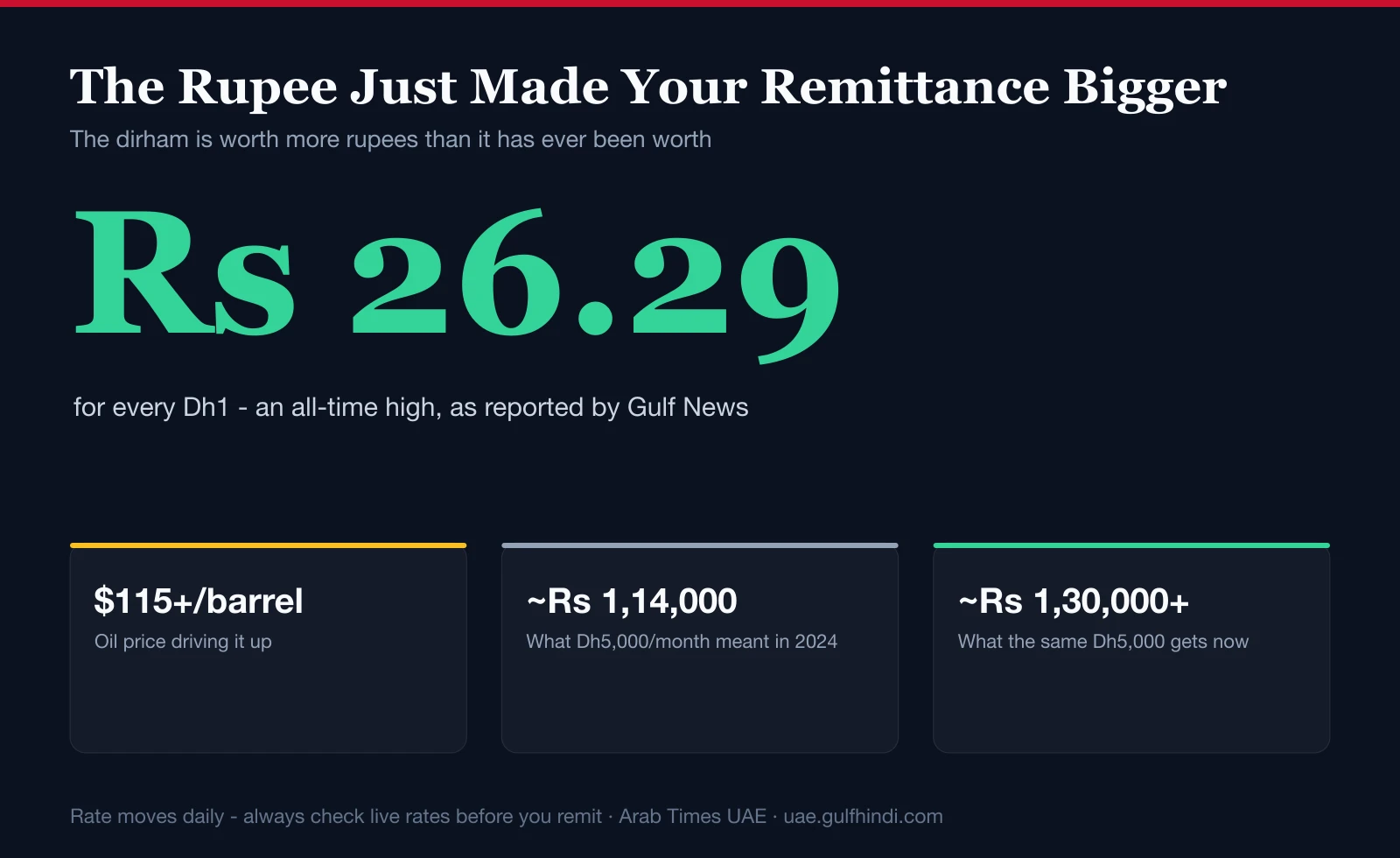
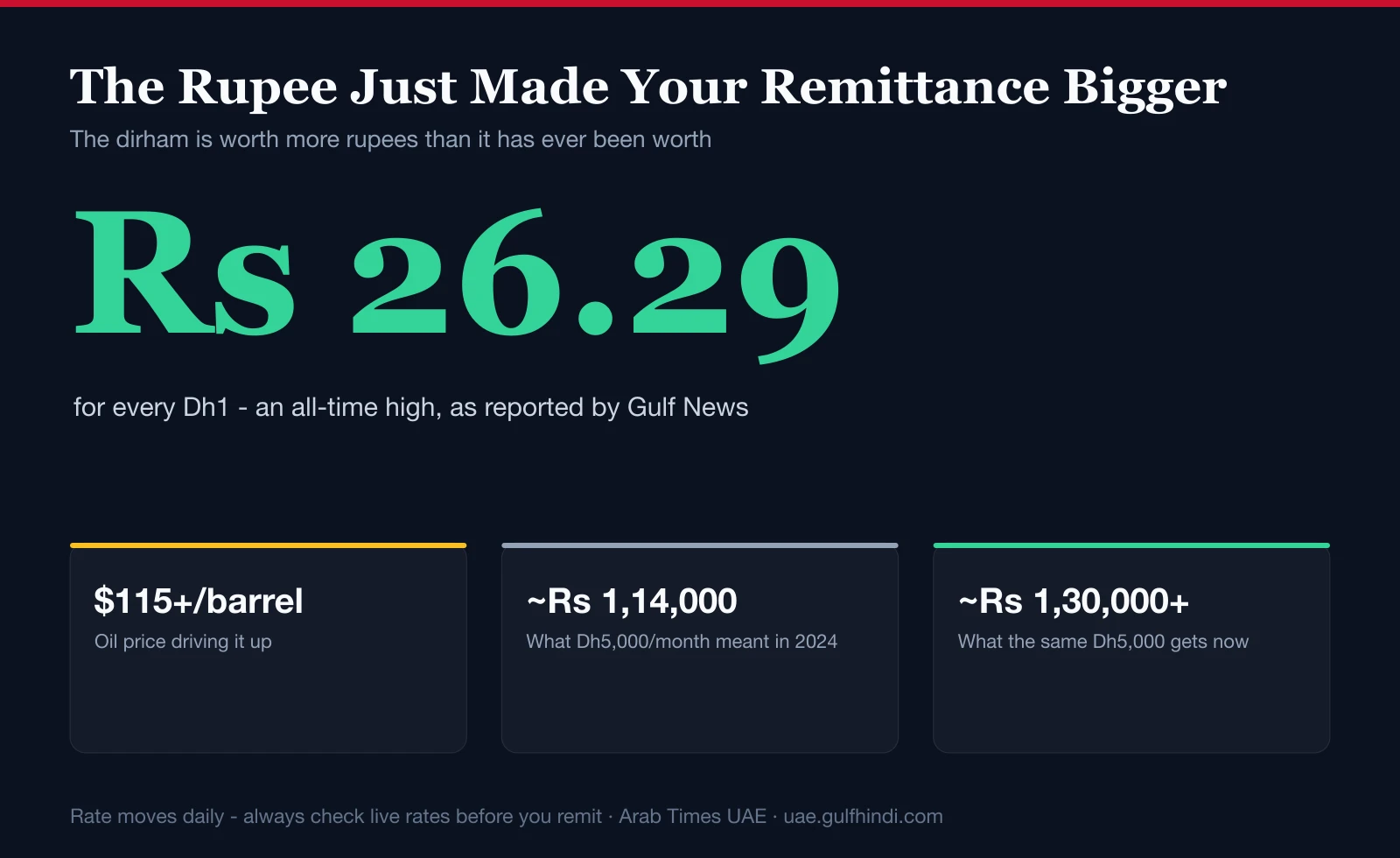
1 UAE dirham was recently worth Rs 26.29 — a record high for the dirham against the rupee, and a record low for the rupee against the dollar, since the dirham is pegged to it. To put that in perspective: a UAE resident sending Dh5,000 home every month would have received roughly Rs 1,14,000 at 2024's average rate. At the rate reported this year, that same Dh5,000 is worth roughly Rs 1,30,000 — nearly Rs 16,000 more, without any raise, any bonus, any change in what you earn.
Why it's happening — and why it connects to this week's headlines
This is the part that ties directly to the flight cancellations and airspace closures you've been reading about all week.
Oil is the driver. Brent crude has surged past $115 a barrel on the back of the ongoing US-Iran standoff and the disruption around the Strait of Hormuz. India imports the overwhelming majority of its oil. When crude spikes, India's import bill spikes with it, and that pressure shows up directly in how many rupees a dollar — or a dirham — buys.
Capital is leaving India. Foreign investors have pulled billions out of Indian equities this year amid the regional uncertainty, adding pressure on top of the oil-driven strain. The result is what analysts describe as a weak balance-of-payments picture, with forecasts of a deficit reaching into the tens of billions of dollars this fiscal year.
The dollar is strong. Hawkish signals from US policymakers have added further strength to the dollar globally — and because the dirham is pegged to the dollar, dirham-denominated remittances ride that strength automatically.
Put simply: the same instability that grounded Etihad's Bahrain flights and thinned out Strait of Hormuz shipping this week is quietly making every rupee-bound transfer from the UAE worth more. One crisis, two very different effects on two different parts of your life.
What this actually means for you
If you send money home regularly — school fees, a parent's medical costs, an EMI, a family budget — this is a genuine, if temporary, gain. Whether or not you should act on it depends on what you're sending for.
If you have a large, planned transfer coming up — a wedding, a property payment, a lump-sum EMI clearance — a record-high rate is worth paying attention to. Locking in a transfer at today's rate rather than next month's could meaningfully change what lands on the other end.
If you remit monthly for routine expenses, the gain is real but should be banked, not spent on the assumption it continues. Exchange rates that move this fast in one direction can move back just as fast — the same Reserve Bank of India intervention that has previously lifted the rupee off record lows before could do so again.
Compare providers before you send, not just the headline exchange rate. Bank transfers, exchange houses and app-based remittance services (several of which now operate in the UAE with Central Bank approval) can differ by a meaningful margin once fees are counted, especially on larger amounts.
The other side of this story
It is worth saying plainly: a weaker rupee is not good news in India. It raises the cost of everything the country imports — fuel first, but also electronics, edible oils and a long list of other goods — and it is a symptom of exactly the kind of regional instability this newsroom has been covering all week. If you have family in India, the remittance windfall on your end is arriving alongside real inflationary pressure on theirs.
The short version
- The rupee hit roughly Rs 26.29 to the dirham — an all-time low against the dirham, driven by a weak rupee against the dollar.
- Oil above $115/barrel, driven by the ongoing US-Iran standoff, is the single biggest factor — the same conflict disrupting flights this week.
- Dh5,000 a month now converts to roughly Rs 1,30,000, against about Rs 1,14,000 at 2024's average rate.
- Rates move daily and can reverse. Check the live rate before any large transfer, and compare providers rather than assuming your usual one is cheapest today.
Whatever else this conflict is costing the region, this week it is quietly putting more money in your family's hands back home. Use the window while it's open.
This article is journalism, not financial advice. Exchange rates change constantly; check live rates before remitting. Corrections: hello@gulfhindi.com.
Graphic by Arab Times UAE.