51.2 Degrees. Here Is Exactly What the Midday Work Ban Requires — and What Breaking It Costs.
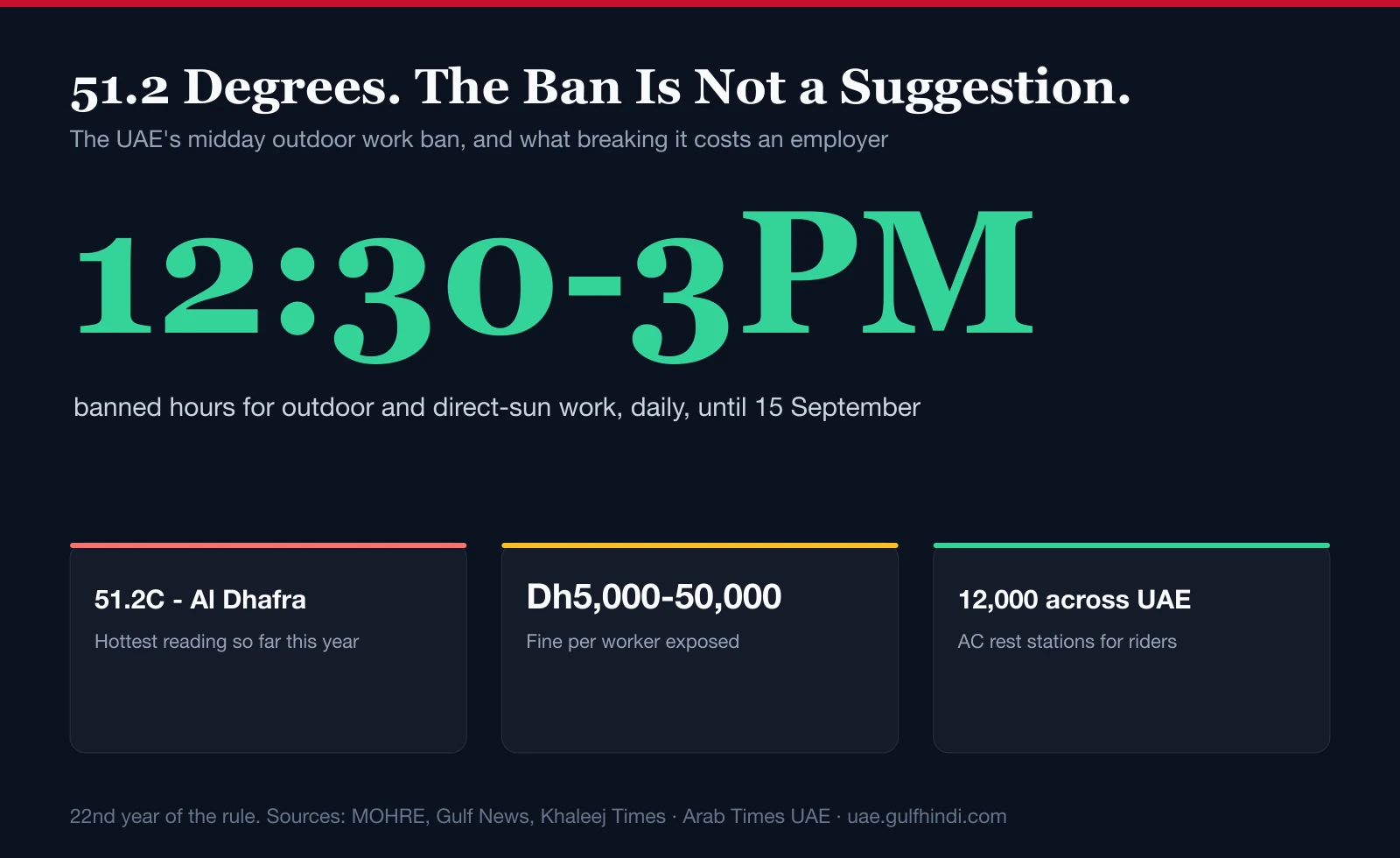
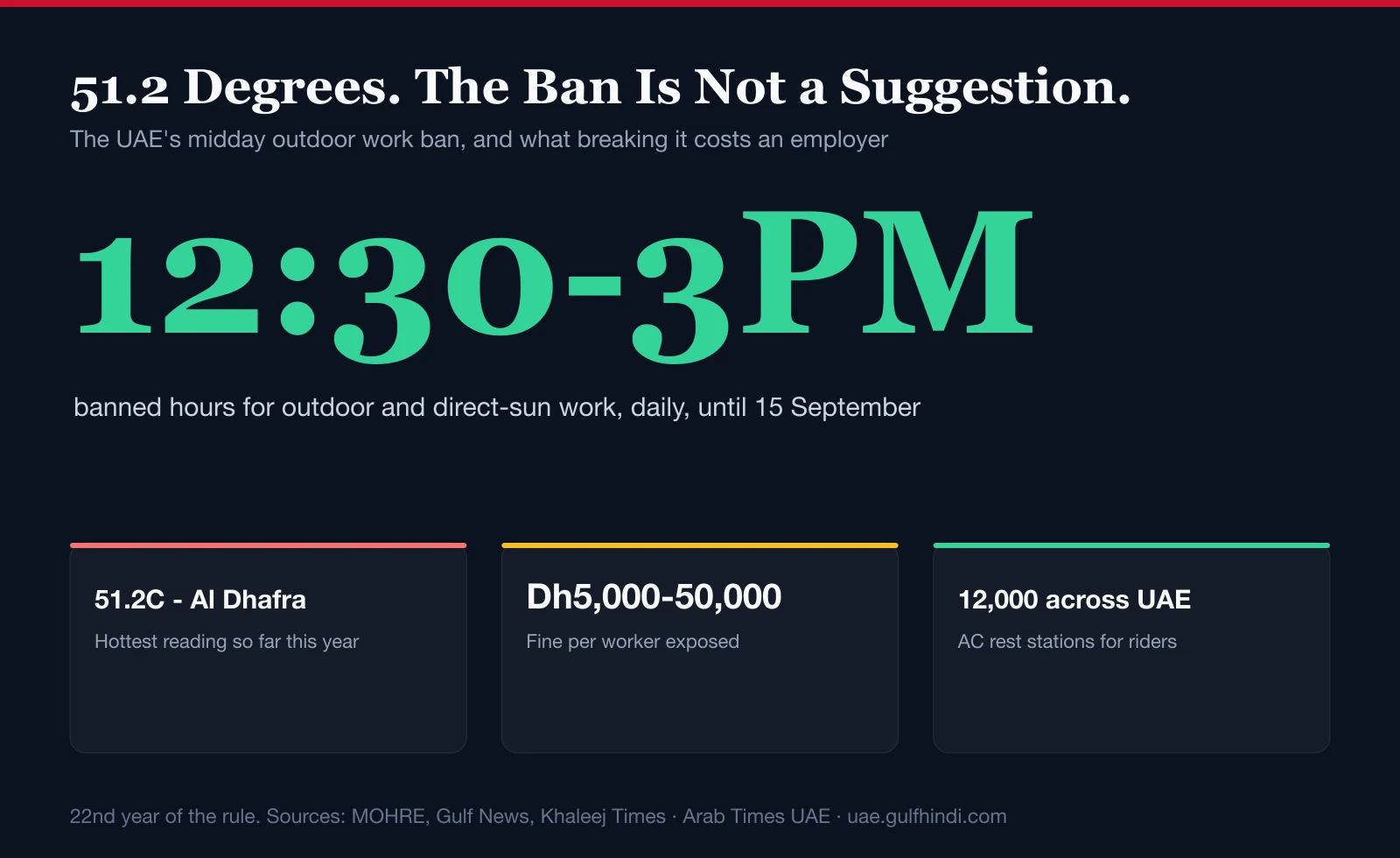
At 2pm on 14 August, a thermometer in Bada Dafas, Al Dhafra, read 50.4°C. Nine days earlier, the same region hit 51.2°C — the hottest reading recorded anywhere in the UAE so far this year. If you have stepped outside in the country this month, you already know the number without needing to see it. What you may not know is exactly what the law requires between now and 15 September, and exactly what it costs an employer who ignores it.
This is now in its 22nd consecutive year. It is not new, but every summer a fresh wave of new arrivals — and plenty of longer-term residents — find out the details the hard way, usually by watching a labour gang keep working through 1pm and wondering whether that's actually allowed.
It isn't.
The rule
All work under direct sunlight and in open areas is banned from 12:30pm to 3pm, every day, from 15 June to 15 September. The Ministry of Human Resources and Emiratisation enforces it across the country, for every outdoor and construction role exposed to the sun during those hours.
During the ban, employers must provide:
- Shaded rest areas
- Cooling equipment
- Drinking water and hydration supplies
- First-aid facilities
What breaking it actually costs
Dh5,000 per worker found exposed to the ban, rising to up to Dh50,000 in total for violations involving multiple workers. Beyond the fine, MOHRE can suspend the company's file, downgrade its classification within the ministry's tier system, and — if the violation results in a worker's injury — refer the case to public prosecution.
MOHRE's field inspection teams are backed by digital monitoring tools built specifically to distinguish between genuinely exempted work and routine outdoor labour that should have stopped for the afternoon. This is not a rule enforced by chance encounter; it is actively hunted for.
The exceptions — and why they exist
Not everything stops. Four categories are exempted, and each has a specific reason:
- Work that cannot be paused or shifted outside the ban hours — laying asphalt or pouring concrete, where halting midway would ruin the material itself.
- Emergency repairs to essential infrastructure — a burst water main or a downed power line does not wait for 3pm.
- Work with prior government approval, where the nature of the project requires special permission to continue.
- Tasks required to prevent immediate danger to people or property.
If you see outdoor work continuing through the ban hours and it doesn't obviously fall into one of these four categories, MOHRE's violation-reporting channel is there for exactly that situation.
If you deliver for a living
Delivery riders are a special case, because the job doesn't stop being needed just because the temperature does. The rule for riders is different from the rule for a construction site: riders may choose whether to work during the ban hours, in coordination with their employer — and MOHRE has been explicit that companies are not permitted to force riders to work during the restricted hours.
If your platform is pressuring you to keep making deliveries between 12:30 and 3pm against your wishes, that is not a grey area. It is a direct violation of the rule protecting you.
To make stopping actually workable, the UAE has built 12,000 air-conditioned rest stations across the country for the summer season — a joint effort between Dubai's Roads and Transport Authority, Abu Dhabi Mobility, Emirates General Petroleum Corporation (Emarat), the major delivery platforms (Talabat, Deliveroo, Noon, Careem, Keeta), and restaurants, malls, retail outlets and cloud kitchens that have opened their doors. This is the fourth consecutive year the network has run. Most delivery apps show the nearest station on an interactive in-app map — check yours before the next 1pm order comes in.
Why this actually matters, beyond comfort
Heat stress is not a discomfort issue at these temperatures — it is a medical one, and the risk climbs faster than the thermometer suggests once humidity is factored in. Warm overnight lows mean outdoor workers, older residents and anyone with an existing health condition don't get the usual overnight recovery either. Standard guidance during this period: avoid strenuous outdoor activity in the afternoon, drink water steadily rather than only when thirsty, and never — under any circumstance — leave a child, an elderly person or a pet inside a parked vehicle, even briefly.
The short version
- 12:30pm–3pm, every day, until 15 September. No outdoor or direct-sun work during those hours, with four narrow exceptions.
- Dh5,000 per worker, up to Dh50,000 total — plus possible file suspension, downgrade, or prosecution referral if someone is hurt.
- Delivery riders can choose to stop, and employers cannot force them to keep working through the ban.
- 12,000 AC rest stations are open across the UAE — check your delivery app's map.
- 51.2°C is the highest reading recorded so far this year, at Al Dhafra on 5 August. The peak of summer is still running.
If you employ outdoor staff, or you are outdoor staff, this is the rule that is actively enforced right now, today, not a seasonal notice nobody checks on.
This article is journalism, not legal advice. Confirm your specific obligations with MOHRE. Report a suspected violation through MOHRE's official channels. Corrections: hello@gulfhindi.com.
Graphic by Arab Times UAE.