Payday Is Now the 1st. Here Is the Clock That Starts If Your Employer Misses It.
Payday used to be whatever date your contract said — the 25th, the 28th, the last working day, whatever your employer preferred. As of 1 June 2026, that is over. Every private-sector salary in the UAE is now due on the first day of every month, for the month before, and the government has built a clock that starts ticking the moment your employer misses it.
If you have ever waited nine, ten, fifteen days for a salary that should have landed already, wondering whether to complain or wait it out — this is the article to read, because most workers still don't know exactly what happens after Day 1, or on which day their employer starts facing real consequences.
The rule, in one sentence
Ministerial Resolution No. 340 of 2026, issued by the Ministry of Human Resources and Emiratisation, sets the first day of every calendar month as the unified deadline for the previous month's wages. Payment must go through the Wage Protection System (WPS) or another ministry-approved channel. Anything paid after that date counts as delayed — officially, immediately, no informal grace period.
There is one built-in cushion, and it matters: a company is still treated as compliant if it has transferred at least 85% of total wages due on time. That is not a loophole for shorting you — it exists so a company is not flagged over a documented deduction or a processing rounding error. If your full salary hasn't moved and it isn't a deduction you agreed to and understand, the company is not compliant, whatever the 85% rule says about its file.
What actually happens, day by day
This is the part worth screenshotting.
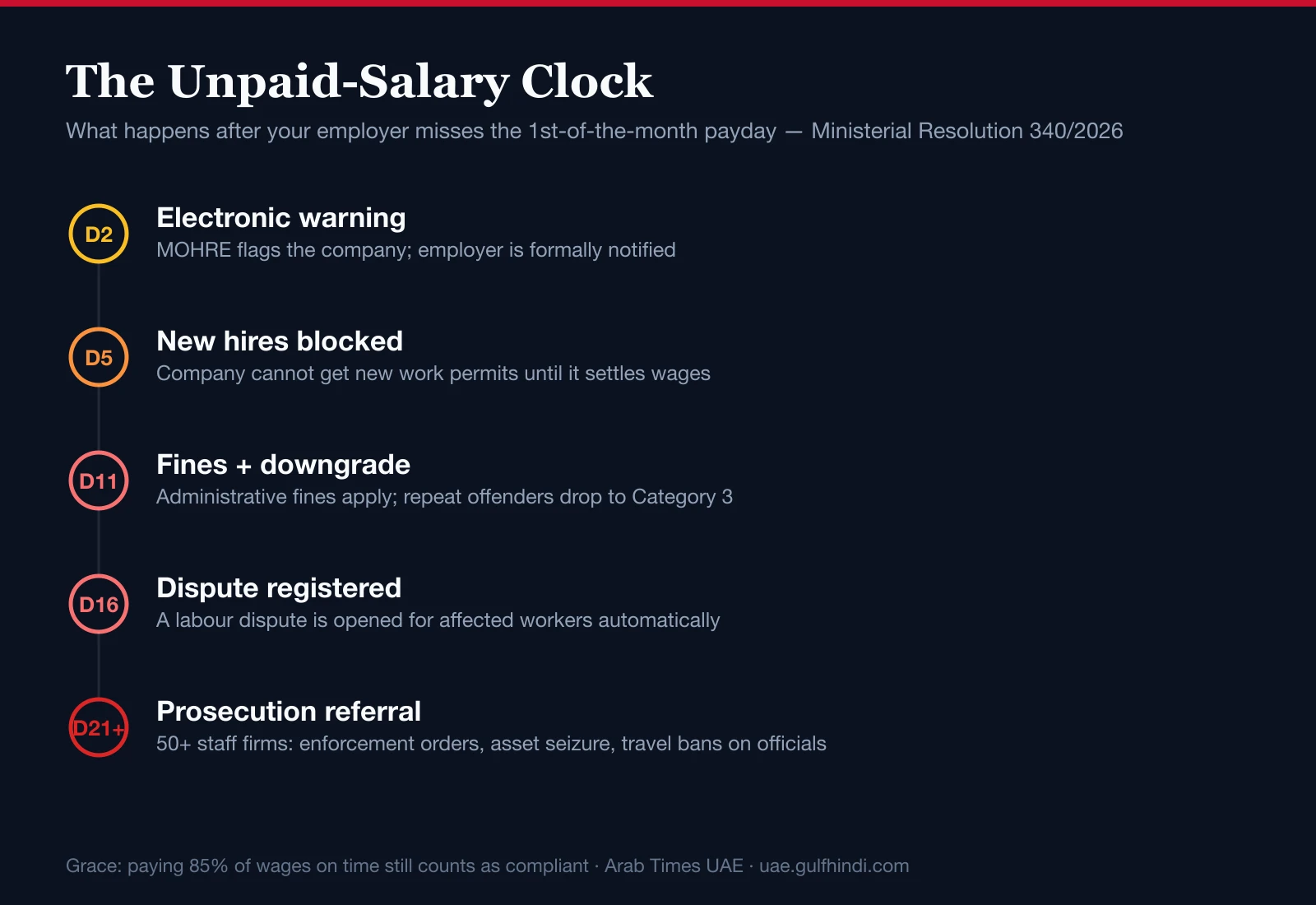
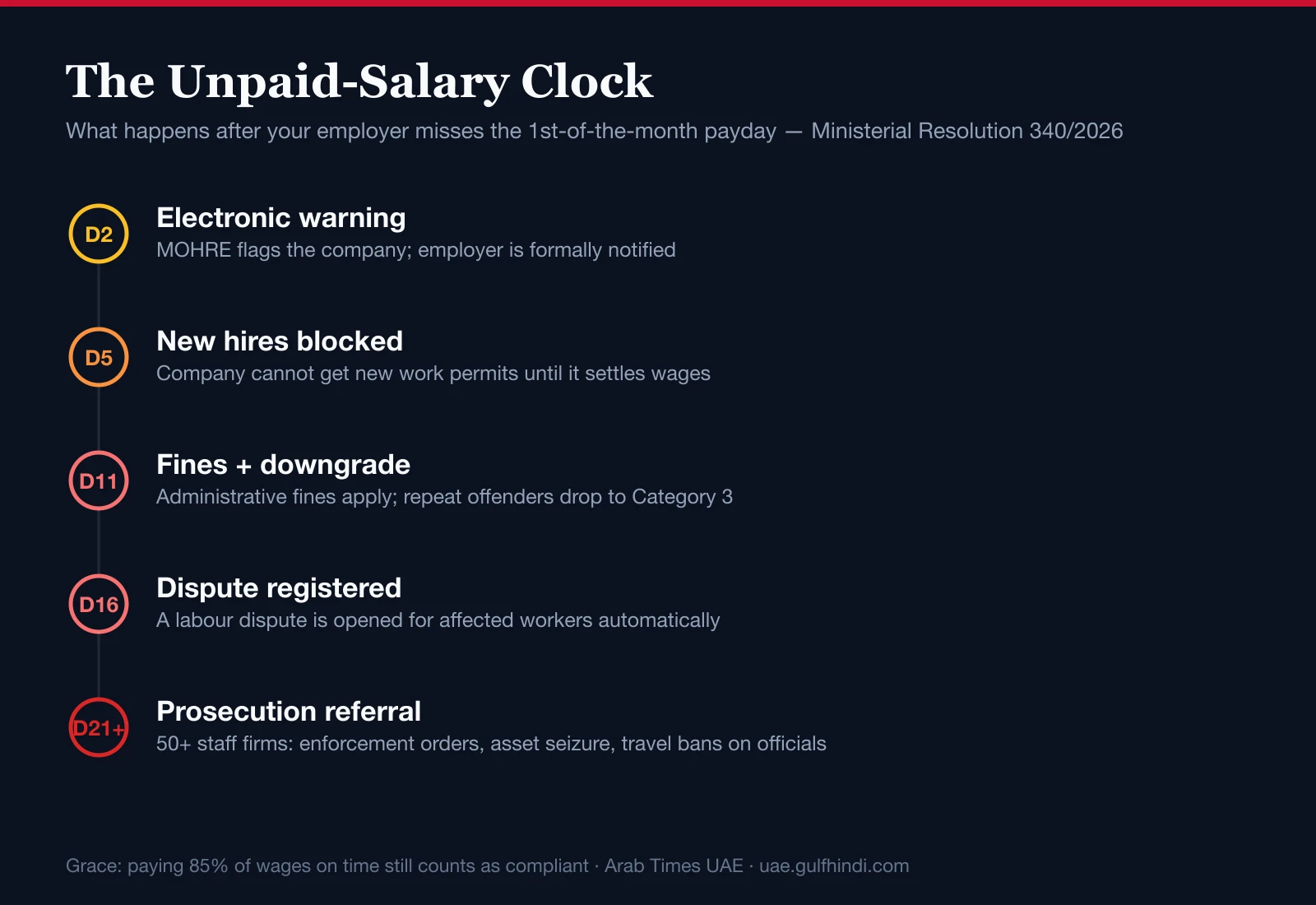
Day 2. MOHRE's electronic monitoring flags the company automatically. The employer receives a formal warning notice. Nothing visible happens to you yet, but the file is open.
Day 5. The company is blocked from obtaining new work permits — it cannot bring in new staff until the wages are settled. This is the first real business cost the employer feels.
Day 11. Administrative fines apply. If the company has repeated this within the past six months, it gets downgraded to Category 3 classification — a status that makes every future government transaction slower and more scrutinised.
Day 16. A labour dispute is registered automatically for the affected workers — you do not need to have filed a complaint yourself. Further work permit suspensions can follow, and companies with 25 or more workers, or operating in construction, transport, storage, security, cleaning or recruitment, face tighter scrutiny from this point.
Day 21 and beyond, for companies with 50 or more employees: this is where it stops being paperwork. Cases can be referred for prosecution, enforcement orders are issued to recover the wages directly, company assets can be seized, and travel bans can be placed on the company's officials.
What this means if you are owed money right now
You do not need to wait for any of these stages to act. The clock runs whether or not you complain, but complaining is what puts your specific case in front of someone.
Check WPS yourself. If your salary normally arrives through WPS, you can see whether your employer has even initiated the transfer. A processed-but-delayed transfer and a transfer that was never sent are different problems with different urgency.
File with MOHRE. A labour complaint can be lodged through the MOHRE app, the ministry's contact centre, or in person. You do not have to wait until Day 16 for the automatic registration — filing yourself starts your specific case moving sooner.
Keep your own record. Payslips, your employment contract's stated salary, any WhatsApp or email promise of "next week", and the dates money did or didn't land. If this reaches a labour dispute, dates are what decide it.
Know that 85% is not the standard you agreed to. Your contract states a number. If you have received most of it but not all, that shortfall is still yours to chase — the compliance threshold protects the company's classification, not your right to full payment.
Why this rule exists
Late wages have historically been one of the most common labour complaints in the UAE, and one of the hardest to act on quickly — by the time a worker filed a complaint under the old system, weeks could pass with no automatic consequence for the employer. The new resolution moves the trigger from "worker complains" to "system detects", which is why the clock starts on Day 2 rather than whenever someone gets around to filing.
For employers, particularly smaller ones, the compressed timeline is real pressure: a cash-flow problem that used to be quietly absorbed over a slow month now becomes a work-permit freeze inside a week.
The short version
- Payday is the 1st of every month, for the month before, since 1 June 2026.
- 85% on time keeps a company technically compliant — it does not excuse the missing 15%.
- Day 2: warning. Day 5: new hires blocked. Day 11: fines, possible downgrade. Day 16: automatic labour dispute. Day 21+: for large employers, prosecution, asset seizure, travel bans.
- You can act before any of these dates — file with MOHRE the moment your salary is late, don't wait for the system to catch up.
If your payday has already passed this month and nothing has moved, today is the day to open a case, not next week.
This article is journalism, not legal advice. Confirm your specific position with MOHRE directly. Corrections: hello@gulfhindi.com.
Graphic by Arab Times UAE.