No, the UAE Did Not Abolish Your Visa Grace Period. Here Is What You Actually Get — 30, 60, 90 or 180 Days.

It usually reaches you through a WhatsApp group, forwarded by someone who works with someone in a typing centre. "Grace period khatam. Ab pehle din se Dh50 lagega." The grace period is finished. From day one, fifty dirhams a day.
It is not true.
The claim has been circulating since early this year on visa-consultancy blogs and aggregator sites, usually phrased with enough official-sounding detail to be convincing — a specific date, a specific figure, a reference to "the ICP announcement". People have paid consultants to fix a problem they did not have. Others have panicked and left the country early, burning a return ticket they did not need to buy.
Here is what the rules actually say, where you can check your own position in about ninety seconds, and what genuinely did change in 2026 — because something did, and it is not what the forwarded message says.
What you actually get
A grace period is the time you may legally remain in the UAE after your residence permit expires or is cancelled. It is not a favour and it is not discretionary. It is a defined number of days, and the number depends on which residence you hold.
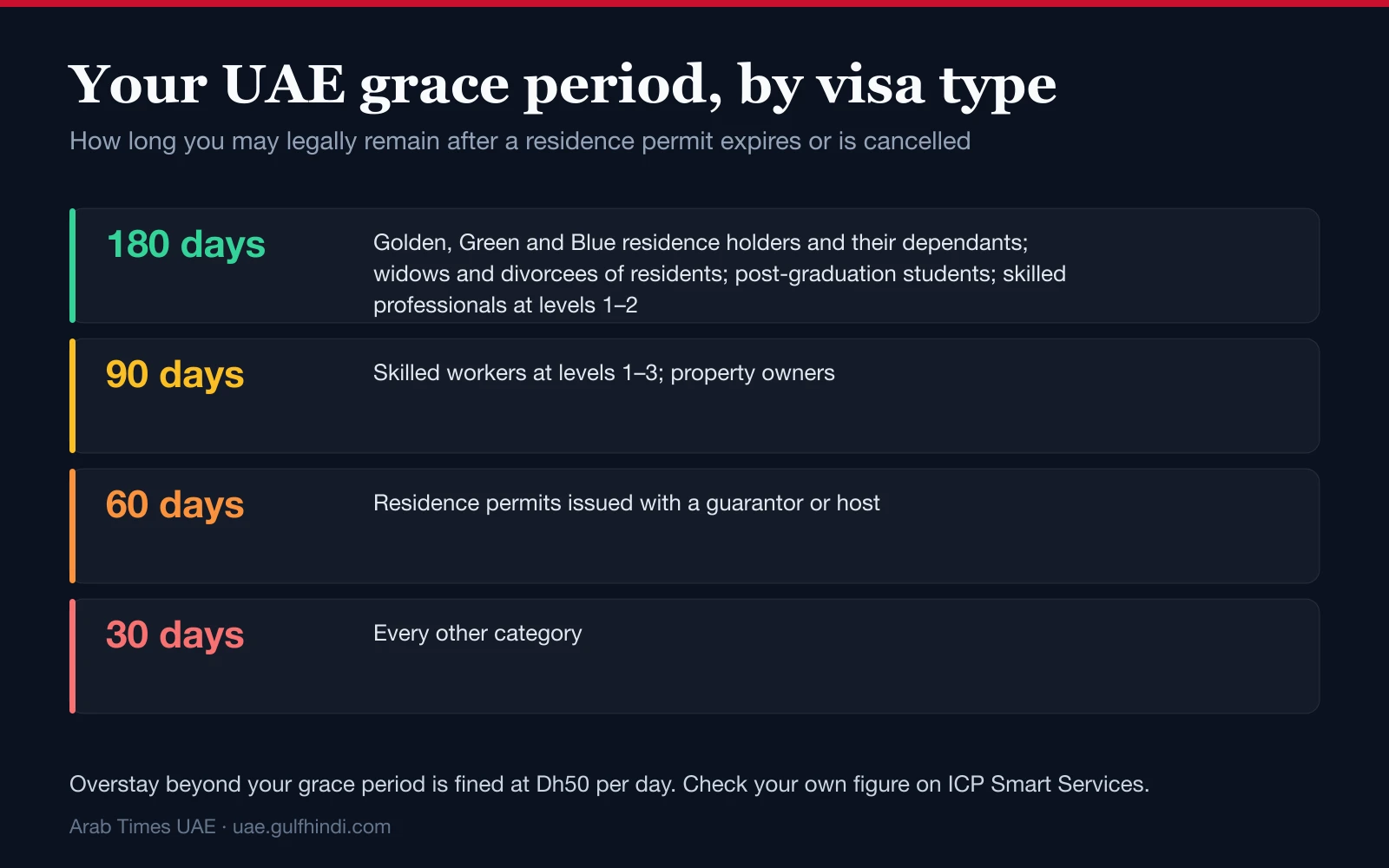
180 days — six months. Golden, Green and Blue residence holders and their dependants. Also widows and divorcees of foreign residents, post-graduation students, and skilled professionals at levels 1 and 2.
90 days. Skilled workers at levels 1 to 3, and property owners.
60 days. Residence permits issued with a guarantor or host.
30 days. Every other category.
That last line is where the confusion starts. Thirty days is the floor, not the rule — it is what applies if none of the categories above fit you. A great many people who have been told "you get 30 days" are actually sitting on 90 or 180.
If you hold a Golden Visa and someone has told you to leave within a month of cancellation, they are wrong by five months.
Check your own number in ninety seconds
Do not take a consultant's word for it, and do not take ours. The immigration authority publishes your own figure, for free.
- Go to ICP Smart Services at
smartservices.icp.gov.ae - Select Public Services, then File Validity
- Choose how to search — by file number, or by passport details with Residency selected as the type
- Enter either your passport number, its expiry date and your nationality, or your Emirates ID / UID / file number
- Add your date of birth and nationality, and click Search
The result shows your allowed days to stay in the country. That is the authoritative number for your specific file. It costs nothing and requires no agent.
Take a screenshot of it. If anyone later tells you something different, you have the government's own answer.

The fine, and where the Dh50 figure really comes from
Overstay beyond your grace period is fined at Dh50 per day.
That figure is real — but it is not new, and it did not arrive in 2026. It came from a restructuring the ICP confirmed back in July 2024, which unified two different rates:
- Residence visa overstays went up, from Dh25 to Dh50 a day
- Visit visa overstays came down, from Dh100 to Dh50 a day
At that time the authority stated plainly that "there has been no change in the fines imposed for overstaying due to a delay in the renewal of the visa or residence permit if the term of one of them expires."
So the Dh50 in the forwarded message is a real number attached to a false claim. It applies after your grace period runs out, not from day one, and it has been Dh50 for two years.
On payment: fines for violations under 30 days can generally be settled at the airport or at the main GDRFA office. Beyond 30 days, you will be sent to GDRFA.
What genuinely changed in 2026
Something real did happen this year, and it is worth understanding properly, because it is almost certainly the seed the rumour grew from.
28 February 2026. Regional airspace closures and flight suspensions, arising from the US–Israel–Iran conflict, left large numbers of people physically unable to leave the UAE. Flights were not delayed; they did not exist.
4 March 2026. The Federal Authority for Identity, Citizenship, Customs and Port Security waived overstay fines for those affected. It covered visit and tourist visa holders whose permitted stay had lapsed, exit-permit holders who had run past their grace period, and residents who had already cancelled their permits in order to leave. It applied to fines incurred on or after 28 February. The authority's stated reasoning was that people should be able to fix their legal status "without imposing any financial burden arising from these exceptional circumstances beyond their control."
10 June to 9 July 2026. The ICP then ran a final 30-day grace period for the people it had exempted, to either regularise their status — through a residency amendment or employment sponsorship — or depart under normal procedures.
9 July 2026. That window closed. Anyone who did not act now faces, in the authority's framing, the normal consequences of overstaying or of failing to hold valid status.
Read that sequence again and you can see how it got garbled. A temporary 30-day window, created for a specific group of stranded travellers, became "the grace period is now 30 days for everyone". A fine waiver became a fine increase. Each retelling shaved off a qualifier.
None of it changed the standard grace-period structure. The 180, 90, 60 and 30-day tiers are what they were.
If you are out of status right now
The July window has closed, so this is the honest position: you have a problem, but it is a solvable one and it gets worse every day you leave it.
- Check your file first on ICP Smart Services, before you assume anything. The number of days you think you have overstayed may not be the number you have actually overstayed.
- Fines can sometimes be reduced or waived on documented humanitarian or exceptional grounds. That is a formal application to the authority, not a conversation at a counter.
- Deal with the authority or a licensed typing centre. Not a WhatsApp contact, and not anyone who asks for your original passport plus a cash fee with no receipt.
- Do not simply wait. Dh50 a day is Dh1,500 a month, and an unresolved overstay follows you into your next application.
Why this keeps happening
UAE visa rules genuinely do change often, and they are genuinely consequential — they decide whether people can work, stay, or bring their families. That combination is exactly what bad information feeds on. A blog post that invents a deadline gets shared harder than an ICP circular that does not.
Three habits that will protect you:
Check the source, not the confidence. A page with no author, no date and no link to an official notice is not reporting. Most of the sites pushing the "grace period abolished" line are visa-consultancy marketing.
Look for a date on the rule, not on the article. A 2026 article can be describing a 2022 change, and often is.
Prefer the authority's own channels. ICP Smart Services, the ICP media centre and GDRFA say what the rules are. They are free, and they are about your actual file rather than a general case.
The short version
- The grace period was not abolished.
- It is 180, 90, 60 or 30 days depending on your residence type — not 30 for everyone.
- The Dh50-per-day fine is real, dates from July 2024, and starts after your grace period, not from day one.
- What happened in 2026 was a waiver for people stranded by airspace closures, plus a temporary 30-day window that ran 10 June to 9 July and has now closed.
- Check your own file at
smartservices.icp.gov.aeunder Public Services → File Validity. Screenshot the answer.
If someone forwards you the message again, send them this instead.
This article is journalism, not immigration advice. UAE visa rules change, and your own file may have circumstances a general guide cannot cover. Confirm your position through ICP Smart Services or GDRFA before acting. Spotted an error? Write to hello@gulfhindi.com — see our Corrections Policy.
Photograph: Terminal A, Zayed International Airport, Abu Dhabi, by Vincent van Zeijst (CC BY-SA 4.0) via Wikimedia Commons. Graphic by Arab Times UAE.