Six Months In, the US-Iran Standoff Has No Exit. Here Is What It's Doing to Your Week.
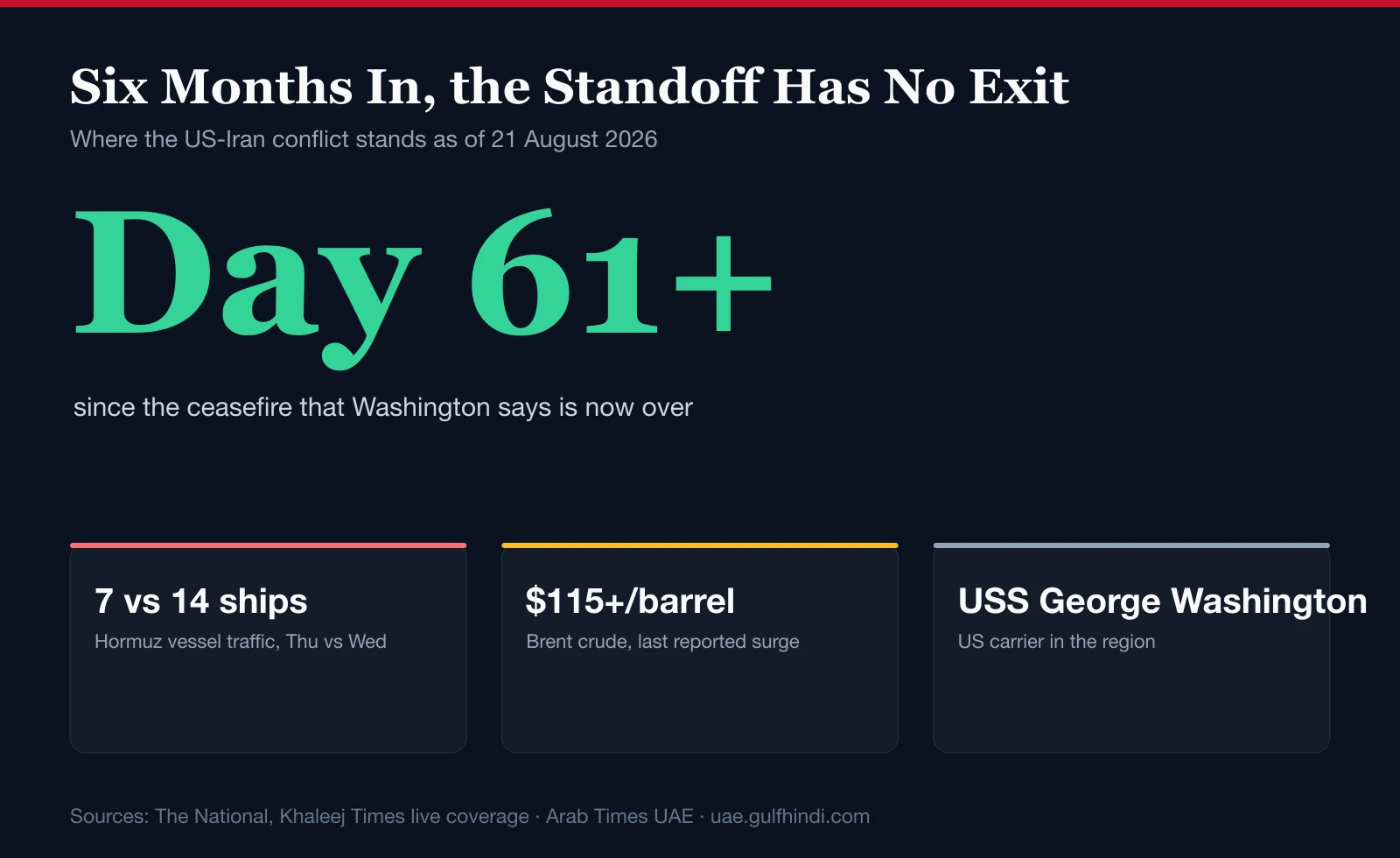
Six months ago, this was supposed to be over by now. There was a ceasefire, a deadline, a sense that the worst had passed. As of 21 August 2026, none of that holds. Washington says the ceasefire is finished, a US aircraft carrier has swapped places with another in regional waters, and the number that best captures where things stand isn't a diplomatic statement — it's a shipping count.
Here is where the standoff actually is today, and what it means for people living a short flight from the middle of it.
The state of play
The ceasefire deadline has expired with no agreement. Talks between the US and Iran ran up against a 60-day window that has now lapsed, leaving both sides at what regional reporting describes as a stalemate. The central sticking point remains control of and access through the Strait of Hormuz — the passage roughly a fifth of the world's traded oil and gas moves through.
Trump has shifted from military pressure to economic pressure. Rather than further strikes, the current US approach is what the president himself has described as an intent to "hit the Iranian economy hard" — sanctions aimed at Iran's trading partners rather than additional military action. Oil prices moved on the threat alone.
Iran and Oman are talking again. The most recent development, reported late on 21 August, is that Iran and Oman are discussing resuming talks specifically around Strait of Hormuz navigation — Oman has functioned as a back-channel between Washington and Tehran through earlier stages of this conflict, and its re-emergence in the conversation is one of the few signals pointing away from further escalation this week.
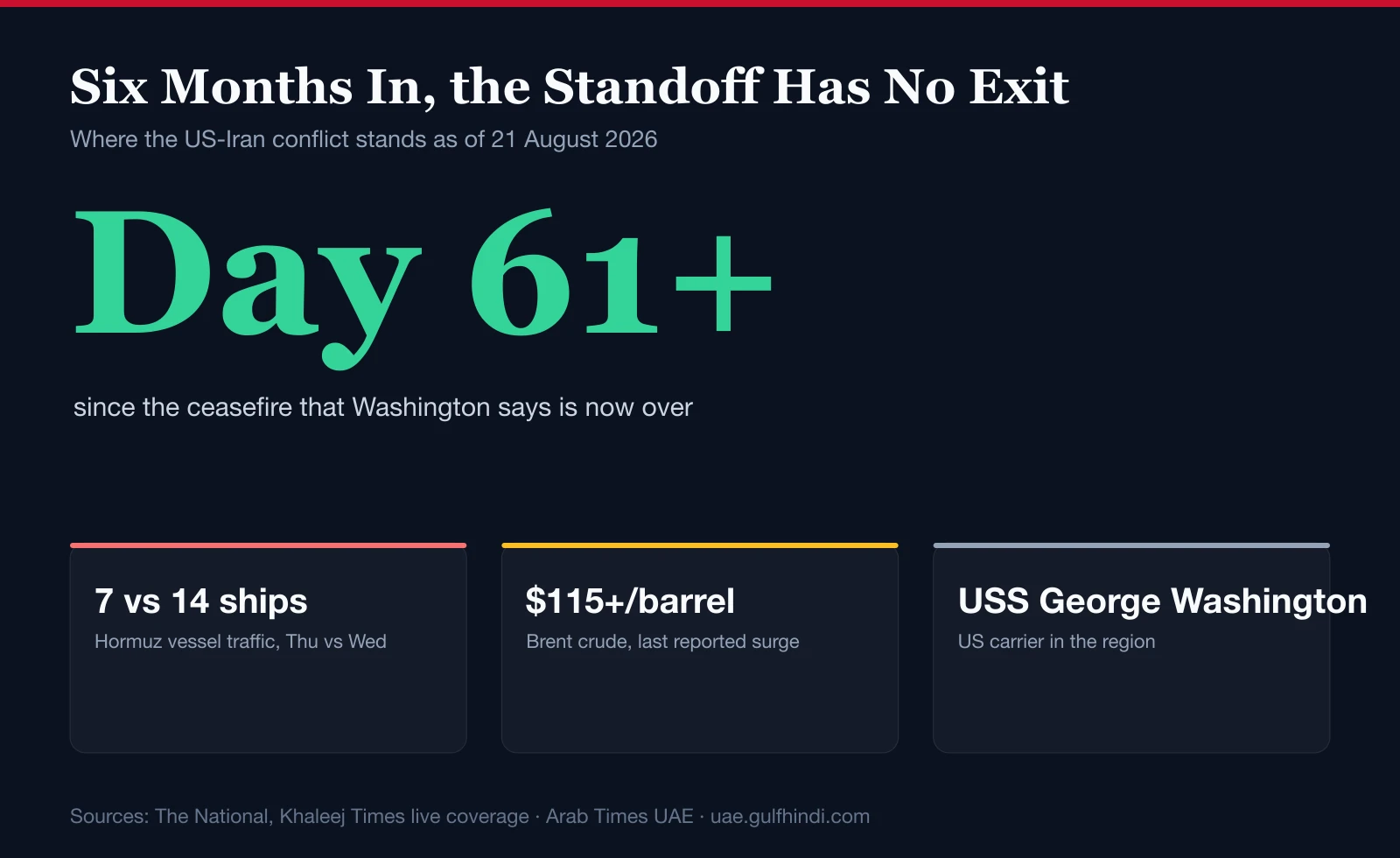
The US naval posture has changed hands, not scaled down. The USS George Washington has replaced the USS Abraham Lincoln in regional waters — a routine rotation, but one that keeps a US carrier group in place rather than drawing down.
The number that tells the real story: shipping
Diplomatic statements are easy to spin. Ship movements are not. Only seven commodity vessels transited the Strait of Hormuz on Thursday, against 14 the day before — traffic through one of the world's most important shipping lanes cut roughly in half in a single day, with no supertankers or LNG carriers recorded at all.
That is not a symbolic gesture. It is shipping companies and insurers making a real-time judgement about risk, and choosing not to send their largest, most valuable vessels through the strait right now.
Oil has responded accordingly. Brent crude has pushed past $115 a barrel on reports that Washington is preparing new sanctions targeting Iran's remaining trade partners — and separately, Iranian oil offers to Chinese buyers, one of Tehran's few remaining major markets, have reportedly softened as the US pressure campaign takes hold.
What this means if you live in the UAE
This is not a distant story. It is the direct cause of the flight cancellations covered on this site this week — Etihad's Bahrain route suspensions, Emirates' Dubai-Bahrain cancellations, Air Arabia's Kuwait and Bahrain disruptions, and airlines like KLM continuing to route around Iranian, Iraqi and Israeli airspace entirely.
It is also, as covered separately today, the reason the Indian rupee has hit a record low against the dirham — the same oil-price surge driving up India's import costs is putting more rupees in every dirham remittance sent home from the UAE.
The UAE itself remains open and operating throughout. Airports are functioning, the currency is stable, and daily life continues — but the knock-on effects, from your flight schedule to your family's exchange rate back home, are running through this conflict whether or not it ever reaches UAE territory directly.
What to watch next
The Iran-Oman talks. If Oman succeeds in reopening a channel specifically on Hormuz navigation, that is the most likely path to shipping — and by extension flights — normalising. Watch for any resumption of supertanker and LNG traffic as the real-world signal, not statements.
The sanctions campaign. Trump's shift toward economic pressure on Iran's trading partners, rather than further military action, is a different kind of escalation — one that plays out over weeks rather than hours, but one that can also draw in other countries' businesses and, potentially, complicate everyday transactions for people connected to the region.
Airline schedule updates. With Bahrain and Kuwait routes still suspended into a third week, any resumption announcement from Emirates, Etihad or Air Arabia will be one of the clearest ground-level signs that the immediate danger has eased.
The short version
- The ceasefire has expired. No new agreement has been reached; Hormuz access remains the core dispute.
- Trump is pursuing economic pressure on Iran's trade partners rather than further strikes, for now.
- Iran and Oman are talking about resuming Hormuz navigation discussions — the most concrete de-escalation signal this week.
- Hormuz shipping is down roughly half, day-on-day, with zero supertankers or LNG carriers recorded — a real measure of risk that statements can't fake.
- The UAE is unaffected directly but is absorbing the knock-on effects — flight cancellations, and a rupee windfall for Indian remitters.
We will keep covering this as it develops, because it keeps reaching into daily life here whether or not a single missile ever crosses into UAE airspace.
This article is journalism, not analysis or forecasting. The regional situation is changing quickly; details may be superseded. Corrections: hello@gulfhindi.com.
Graphic by Arab Times UAE.